The MGS Blog

Friday, October 7, 2016

How ICT sourcing and development affects social development

Working Group 9.4 from the International Federation for Information Processing (IFIP) is a scholarly forum for dealing with the issues ICT impacting social development.

The IFIP 9.4 Working Croup has a series of scholarly conferences that seek critical perspectives on processes of growth and development, inclusiveness and social transformation through the impacts of global ICT and BPO sourcing.
http://2017.ifipwg94.net/tracks/track-09-global-sourcing-and-development/
(also see
Submission deadline: November 15, 2016
Mt Merapi, the most active volcano in Indonesia (image source Wikipedia)
Our interest is in how ICT sourcing and globally distributed software development activity is implicated in local social development in the regions from which these activities are sourced. Going one step further we assert that the research object of a 'national' need and response is too abstract, that we need to understand the local rather than national context if meaningful engagement in development is to occur. This is because the more abstract the concepts the more easily does organisational and social action dissipate, thus loosing its efficacy and meaning. Worse, they may be subverted as resources by and for other actors and power interests (Cooke, B, 2004). Postcolonial critics of international development drawing upon 'subaltern studies' have exposed global, regional, and national inequalities. Subalterns reveal workers subjectivities in situ, from the local's perspective rather than the development or governmental agency.

One strand of theorising how inequalities arise against people's best intentions is through the unintended consequence of language games in public discourse. Organisation and management theorists assert that the use of spatial signifiers produces actual idealogical realities in the field of international development. That is, spatial labels produce the categories they refer to. This is an old trick from the days of colonialisation, to label the other (the developing or underdeveloped world) in contrast to the West, or the Northern Hemisphere or developed economies etc. The consequence is to justify and legitimise various national, governmental, organisational and managerial interventions in international development (Gupta, 1998).


References and further reading:
Cooke, B. (2004) ‘Managing the (Third) World’, Organization 11(5): 603-629.
Gupta, A. (1998) Postcolonial Developments: Agriculture in the Making of Modern India, Durham, NC: Duke University Press.

also see 43-CMS-2017-Stream-Proposal-Global-South-reconfigured-1.pdf

Thursday, April 21, 2016

Asia-Pacific Global Sourcing Conference

23-25 September 2016
Renmin University, Beijing, China

A call for Papers for the 1st Asia-Pacific Global Sourcing Conference, which will be held on September 23-25, 2016 in Renmin University of China, Beijing, China.

See the website

The conference will aim to explore how new and emerging forms of outsourcing and offshoring challenge sourcing practices and theories, and consequently identify new directions for research and practice. The conference aims to bring together viewpoints from various disciplines, including information systems, international business, operation management and strategy on global sourcing of IT, Business Services and Innovation.

The keynote speech will be delivered by Professor Sirkka Jarvenpaa, Rauscher Pierce Refsnes Chair in Business Administration, University of Texas at Austin. Prof. Jarvenpaa is known for her academic leadership in inter-organisational research, focusing on collaborative modes including outsourcing.

Paper Track


Research articles, work in progress and ‘focus on practice’ papers that investigate topics relating to global outsourcing and offshoring. Some of the specific themes that are of interest include:


* Sourcing decision making
* Sourcing configurations (multi-sourcing, plural sourcing, supplier networks, eco-systems)
* Relational and contractual governance issues
* Supplier and client capabilities and competences
* Innovation through outsourcing
* Cultural and social issues
* Knowledge issues in outsourcing
* Impact sourcing
* Automation in outsourcing
* Cloud services (as service economy)
* Crowdsourcing
* Repatriation/backsourcing

We are interested in papers that are both conceptual and empirically based.

Selected papers from the conference will be published as book chapters in Lecture Notes in Business Information Processing<http://www.springer.com/series/7911> (by Springer<http://www.springer.com>).

Important Dates:
· May 30th 2016: Registration opens
· June 10th 2016: Deadline to submit extended abstract
· June 17th 2016: Notification of accepted extended abstract
· August 1st 2016: Early registration deadline
· August 20th 2016: Deadline to submit full paper
· September 23-25 2016: Conference

Extended abstracts should be in English, between 600-800 words and should include contact details of all authors. Full papers (in English) should not exceed 9,000 words.
All submissions should be sent in MS Word format to: asia.pacific.globalsourcing@gmail.com<mailto:asia.pacific.globalsourcing@gmail.com>
with 'Abstract submission APGSC 2016' as the subject of the e-mail.

Tuesday, April 19, 2016

Research articles and areas

You will find articles in academic journals via the UCD Library pages, making sure you are logged into UCD Connect first so that the University's journal access permission is activated.

Two sites worth looking at for both themes and research paper template (look for submission guidelines).
The AIS hosts a digital library, publicly searchable. The AIS library is available at
http://aisel.aisnet.org/ (access is restricted to members of the AIS)

Thursday, April 14, 2016

Answering questions and grading

I use grade descriptors (A+, A... C-, D+ etc) rather than % grades. You should search UCD for definitions/explanations of grade descriptors. I have posted similar material on the website.
In terms of answering prosaic, essay style questions you can employe a couple of approaches, they all amount to the same thing however, know your material, produce your own thoughtful response, practice using past papers.
Sometimes students struggle more with organising their thoughts, the following might be of help:

A simple style of raising questions, responding, and further questioning responding in the Socratic style is ok. So long as you demonstrate your knowledge and answer the question.

In terms or organising your thoughts, as mentioned in class the so-called Hegelian approach; thesis, anti-thesis, synthesis might be useful:

1. Simple bullet points >
2. Detailed definitions >
3. Examples of application >
4. Critical analysis of practical use >
5. Own interpretation and synthesis >

In a similar fashion you might organise a response inspired by Bloom’s cumulative (classification) of knowledge :
1.Data/factual statements (rules)
2.Simple description, explanation (theories)
3.Straight forward application, applied
4.Analysis of unexpected outcomes
5.Synthesis of new or adapted theory
6.Expert reflective application in use.

Tuesday, April 12, 2016

Own team offshore?

This is a key question for startups, to build your own team or to outsource? Although some organisations have had great experiences building tech purely through outsourcing relationships, nearly everyone advises build your own team, without fail.
But what if you're too small to attract high calibre talent locally or the local market is too small and overheated (Dublin, Ireland anyone?)?
Yousef Awad has written an interesting reflection addressing these questions and his learning from the experience. It's an InfoQ post titled "Build Your Own Offshore Development Team - or Not?"
He is of the opinion that you can and should outsource development when starting out, and continue to do it if you start bringing the work back in-house.

Thursday, April 7, 2016

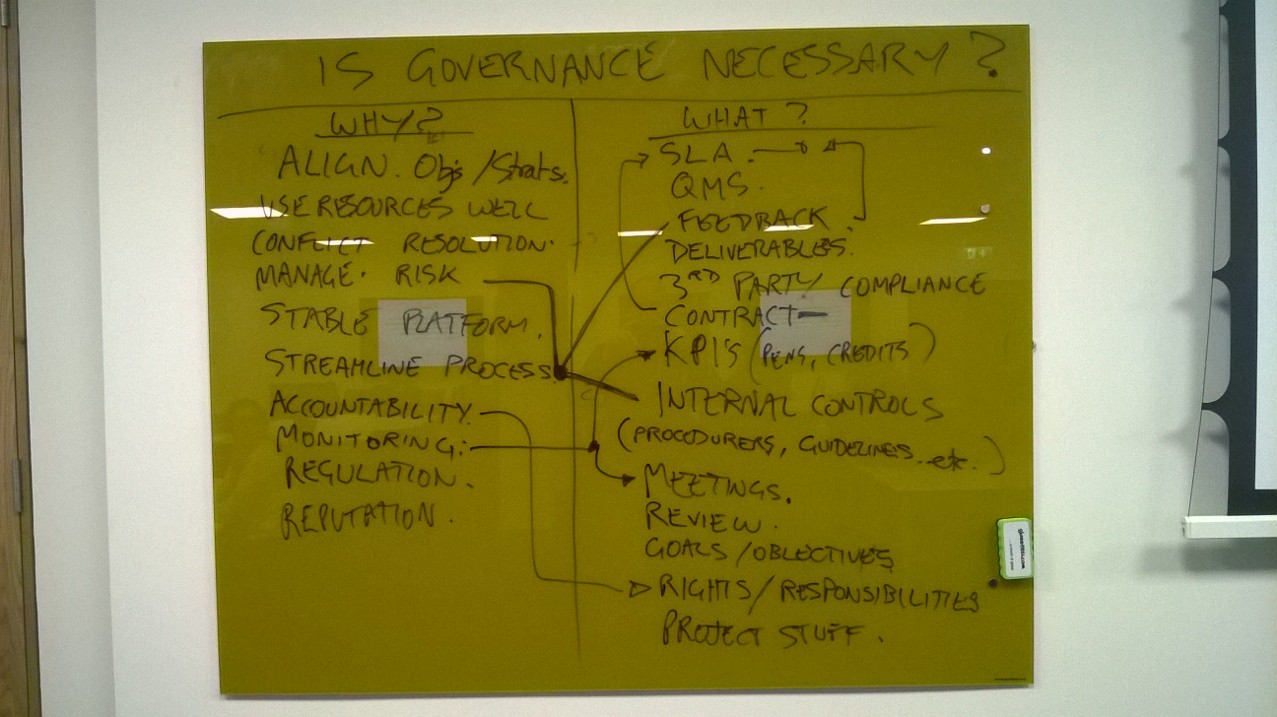
Governance white board

Notes collected from the workshop on governance.

Wednesday, April 6, 2016

Crowd and Microsourcing, who wins, who loses?

Microsourcing, who wins, who loses? Gefen & Carmel (2008) suggest microsourcing works well for the small supplier, and Lehdonvirta's research appears to confirm it (look at slides 9 onwards). Microworkers appear to be treated more equitably.


Gefen & Carmel (2008) show that cost is a significant driver towards microsourcing, but access to skills seems to be a strong incentive for customers to source directly from micro suppliers. Why do the most sophisticated (US) markets seek these offshore micro-suppliers? Principally to address resource shortages in their local markets and furthermore, customers return to the same supplier if initially satisfied and continue to pay a ‘fair price’. The satisfied customer returns again and again, caring less and less if the work is offshore, caring more that they have access to the specialist wherever they are. The world hasn't been 'flattened' (Friedman, 2005), but it appears to be 'flatter'.

References
  • Friedman, T. L. (2005) The World Is Flat: A Brief History of the Twenty-first Century, Farrar, Straus & Giroux.
  • Gefen, D. & Carmel, E. (2008) Is the World Really Flat? A Look at Offshoring at an Online Programming Marketplace. MIS Quarterly, 32, 367-384.
  • Carmel's student microsourcing exercise (errancarmel.blogspot.com)