#DigiInnos Tweets
Tuesday, February 21, 2017
Tuesday, February 14, 2017
StaffVirtual - Philippines
StaffVirtual provide BPO and ITO based in the Philippines. These are specialist services delivered digitally by highly educated, skilled, talented, committed, people based in the Philippines.
What capabilities make these services valuable and attractive to distant clients?
What are they doing that enables them to ‘fit’ or ’match’ the client?
http://www.staffvirtual.com/
What capabilities make these services valuable and attractive to distant clients?
What are they doing that enables them to ‘fit’ or ’match’ the client?
http://www.staffvirtual.com/


Monday, February 13, 2017
IAM 2017 Call For Papers
The 2017 Irish Academy of Management (IAM) Conference is being hosted by Queen’s Management School, Queen’s University Belfast, from the 30th August to the 1st September, 2017.
Abstracts will be double peer-reviewed. Submission details and further information about the conference can be found on the conference website.
www.iamireland.ie
We look forward to welcoming you to Belfast!
Dr Geoff Simmons and Dr Kristel Miller
Conference Chairs, Queen’s Management School
E-mail: IAM2017@qub.ac.uk
Abstracts will be double peer-reviewed. Submission details and further information about the conference can be found on the conference website.
www.iamireland.ie
We look forward to welcoming you to Belfast!
Dr Geoff Simmons and Dr Kristel Miller
Conference Chairs, Queen’s Management School
E-mail: IAM2017@qub.ac.uk
Wednesday, February 8, 2017
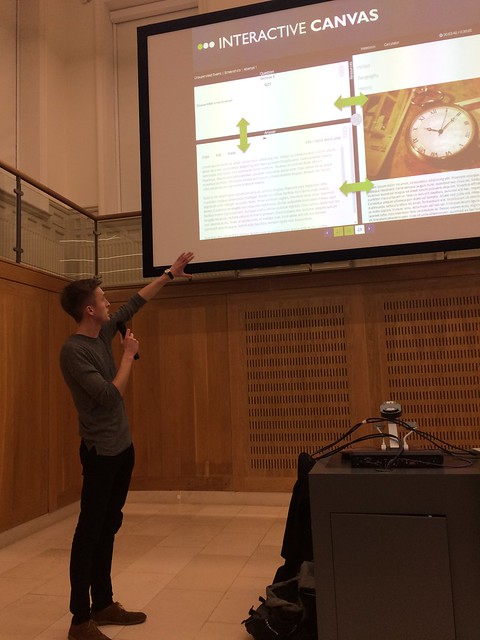
Seminar - TestReach; the Online Testing and Supervision Company
[guest lecture] Louella Morton and Brian Mc Hugh (12:00pm midday Tuesday) 7th Feb - TestReach - Online Testing and Supervision. A talk on TestReach's corporate development, philosophy, history, organisation, approach to product management and product design. http://www.testreach.com/
Tuesday, February 7, 2017
Version1 Seminar 2017
 |
| Peter Smyth: Head of Managed Services, Version 1 |
[guest lecture] Peter Smyth (5:15pm Monday 6th Feb in room N303) - Verison1 the Irish Consulting, Solutions and Outsourced Managed Services Company. Procurement stories and Agile serverless technologies. http://www.version1.com/
Thursday, February 2, 2017
PMIA Seminar
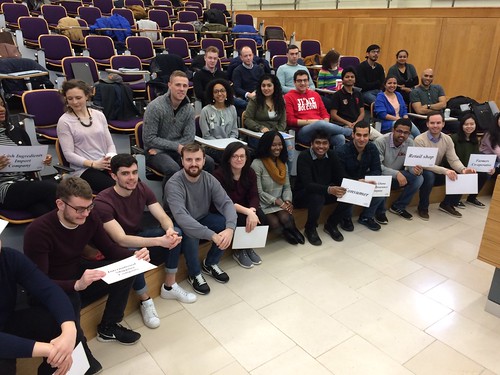 |
| Ready for the value chain exercise. |
Look out for the value chain exercise captured in stop-motion.
PMIA : Proudly Made In Africa: value chain exercise from Allen Higgins on Vimeo.
Friday, October 7, 2016
How ICT sourcing and development affects social development
Working Group 9.4 from the International Federation for Information Processing (IFIP) is a scholarly forum for dealing with the issues ICT impacting social development.
The IFIP 9.4 Working Croup has a series of scholarly conferences that seek critical perspectives on processes of growth and development, inclusiveness and social transformation through the impacts of global ICT and BPO sourcing.
http://2017.ifipwg94.net/tracks/track-09-global-sourcing-and-development/
(also see
Submission deadline: November 15, 2016
The IFIP 9.4 Working Croup has a series of scholarly conferences that seek critical perspectives on processes of growth and development, inclusiveness and social transformation through the impacts of global ICT and BPO sourcing.
http://2017.ifipwg94.net/tracks/track-09-global-sourcing-and-development/
(also see
Submission deadline: November 15, 2016
 |
| Mt Merapi, the most active volcano in Indonesia (image source Wikipedia) |
Our interest is in how ICT sourcing and globally distributed software development activity is implicated in local social development in the regions from which these activities are sourced. Going one step further we assert that the research object of a 'national' need and response is too abstract, that we need to understand the local rather than national context if meaningful engagement in development is to occur. This is because the more abstract the concepts the more easily does organisational and social action dissipate, thus loosing its efficacy and meaning. Worse, they may be subverted as resources by and for other actors and power interests (Cooke, B, 2004). Postcolonial critics of international development drawing upon 'subaltern studies' have exposed global, regional, and national inequalities. Subalterns reveal workers subjectivities in situ, from the local's perspective rather than the development or governmental agency.
One strand of theorising how inequalities arise against people's best intentions is through the unintended consequence of language games in public discourse. Organisation and management theorists assert that the use of spatial signifiers produces actual idealogical realities in the field of international development. That is, spatial labels produce the categories they refer to. This is an old trick from the days of colonialisation, to label the other (the developing or underdeveloped world) in contrast to the West, or the Northern Hemisphere or developed economies etc. The consequence is to justify and legitimise various national, governmental, organisational and managerial interventions in international development (Gupta, 1998).
References and further reading:
Cooke, B. (2004) ‘Managing the (Third) World’, Organization 11(5): 603-629.
Gupta, A. (1998) Postcolonial Developments: Agriculture in the Making of Modern India, Durham, NC: Duke University Press.
also see 43-CMS-2017-Stream-Proposal-Global-South-reconfigured-1.pdf
One strand of theorising how inequalities arise against people's best intentions is through the unintended consequence of language games in public discourse. Organisation and management theorists assert that the use of spatial signifiers produces actual idealogical realities in the field of international development. That is, spatial labels produce the categories they refer to. This is an old trick from the days of colonialisation, to label the other (the developing or underdeveloped world) in contrast to the West, or the Northern Hemisphere or developed economies etc. The consequence is to justify and legitimise various national, governmental, organisational and managerial interventions in international development (Gupta, 1998).
References and further reading:
Cooke, B. (2004) ‘Managing the (Third) World’, Organization 11(5): 603-629.
Gupta, A. (1998) Postcolonial Developments: Agriculture in the Making of Modern India, Durham, NC: Duke University Press.
also see 43-CMS-2017-Stream-Proposal-Global-South-reconfigured-1.pdf
Subscribe to:
Posts (Atom)