The MGS Blog

Monday, January 24, 2022

DataCamp 2022 Outsourcing

This class has educator access for six months to DataCamp.

DataCamp for Classrooms access equates to full Professional access for a period of six months for all members of the account. Students and teachers have access to every piece of content on DataCamp (except for courses in Tableau, Power BI, and Oracle).

Access to self-directed and self-paced learning with "DataCamp's growing curriculum of expert content—designed for students of all data skills and levels."

Saturday, January 15, 2022

Cases - analysis/learning/synthesis

Possible ways to respond to a case. These approaches can be used for your own engagement with the mini cases. But note, you must bring your own creative spark to case analysis/learning/synthesis. The following is for inspiration and guidance and is not intended to be overly prescriptive.

Read the case. Search for and read relevant article(s) and books.
What made you curious? Have you further questions about any aspect of the case?
Identify learning-points, challenges or problems evident in this case.
Disclose personal experience, knowledge and skills you have relating to the area.
What personal knowledge gaps has the case revealed for you?
Provide evidence of key learning sources you identified to address the questions raised by you about the case and used by you to bridge your personal knowledge gaps.
Propose concrete actions (not mere recommendations) that you would employ in theory to address the case and/or to your own future projects based on the learning you gained from the case.

One possible approach to encapsulating your case analysis/learning/synthesis: 
Write 'Action Item' statements applicable to your own practice/team/company/and-or-the-case. Each Action Item to be a single (long) sentence covering the basics...
  • (Why) reasons linked to specific observation(s) based on or related to the case;
  • (What) elaborating on selected element(s) linking the case context with additional research/readings;
  • (How) 'for examples' suggesting things to be done that activate the recommended action item in a practical manner.

Friday, January 14, 2022

Exercise: Global Pharma (case)

Exercise: 15"

Read the case (again): 5"

In groups assess the suitability of one of the following areas for a pharmaceutical firm's sourcing strategy...
  • Email
  • ERP
  • MRP
  • HR
  • LIMS
  • Plant control systems
  • Public/market/marketing content management websites
  • Internal documentation and content management intranets
  • Storage
  • Collaboration technology
  • Logistics (3PL)
  • Regulatory compliance
Applying one or more of the instruments from chapter 2 to this example.

Debrief: 15"
Report to the class…

  • Service categories: General Business / Unit or Site Specific (HR, Finance etc) / Industry Specific

  • Strategy recommendation?

  • Cloud? / In-House? / On-Shore? / Off-Shore? / 3rd Party? /

Managing Global Local (sourcing case)

Interview with Declan, Project Programme Manager - Dublin.

"Bringing this project up to the starting line is a story in itself however I can say we had a great start. A really compelling prototype, demonstrated all the key functionality; web access, cloud data, simple workflow, fine grained ownership with security, reporting, detailed versioning, multilingual. We demonstrated the capacity to delivery a key internal service to the global company. You don't really need to know too much about the detail."

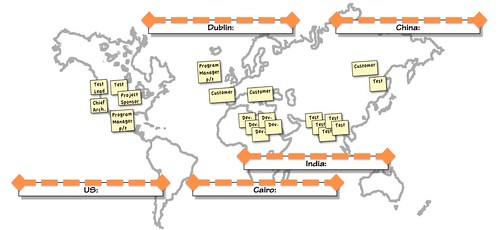
"The initial prototype was a joint production between Santa Monica (US) and Dublin, we pitched the project at our quarterly Knowledge Exchange event. In the company we call this kind of bidding process 'outsourcing inside'. We ended up with bids from three other groups, from our offices in Cairo (Egypt), Pune (India) and Langfang (China). Some of them signed up as 50% 'own time', the others were full-time. Cairo provided full-time developers, Langfang and Pune gave us full-time testers (figure 1)."
cloballocal
Figure 1. Global-Local initial project team

"We applied formal project planning from the start. The project is outsourced to multiple sites so a number of different cultures are involved. From our video calls I can say that the physical environments at all sites appear to be open plan cubicle formats, or 'tube-farms'. It is a tribute to the whole team that a passion for quality and for doing the job well has remained throughout and that is common across all geographies."

"The working cultures have little differences from office to office but I can say that's a strength. The vendor development team in Cairo appear to think little of working 24 hours a day, 7 days a week if they feel it necessary. Some of the flexibility shown in Cairo has its cost. After a 'spike' of effort they need to recover before reverting to normal working hours, inevitably your life outside (or lack of sleep) catches up with you. Those of us in Dublin and the US, we need our sleep and breaks just a little more but we're nearly always on hand to check mail, and, if necessary, work at weekends too. The test teams in India and China are very structured, very productive, and seem to always work the same hours, sometimes little later on busy weekdays, very rarely at weekends. In contrast, the part-time nature of the involvement of some of the players contributes to a certain lack of accountability, after all this isn't their 100% day job. You might load a work-task in Project at 50% but they aren't really able to allocate 50% all the time."

"With the number of locations involved in conference calls we've found that verbal communications can be a big problem. The mixture of accents in each office is compounded by differing audio quality across the sites. Audio and video quality degradation is just unavoidable. We're a global technology leader and only use best-in-class systems and still it's difficult to have perfectly clear group discussions. I think it has been a factor in generating some miscommunication."

"But the situation we're dealing with now... The formal project management approach requires an initial design process, very structured, heavy on documentation and long-winded. Crucially we agreed on multiple customers with different requirements, so every possible feature requirement was included in the plan from the start. You could say, with three customers the project might lack a certain direction. The customers (and I suspect architects) were essentially free to add their own personal dreams into the requirements and specifications. The requirements are also 'moving targets' because the goals of the different customer groups have shifted over time."

"We followed formal project planning practice, a one year schedule with three major milestones: alpha, beta, general release. Each feature had a feature spec written, subjected to a review and sign-off meeting. Feature spec review and sign-off ends up being quite lengthy and it has to happen for each feature. After the feature specification is nailed down the developers create a detailed design spec. This hammers out the finer details of the features. The test teams use the design spec to write a test spec and start generating 'white box' tests. The developers take the design specs and implement them. "

"It was pretty obvious that the formal approach takes time, but it can also lead to over engineered feature specifications. This causes problems elsewhere because of integration, features have to work with each other, and the interdependencies are complicated in unexpected ways. The alpha milestone was the point where first draft features were integrated. Debugging these interactions and interdependencies takes more time and generates further instabilities."

"It quickly became clear that while the features had been highly designed, perhaps even 'over engineered', their integration with each other was troublesome. While it had been considered during design it was obvious that each feature's designer should have studied the interfaces with the others far more closely. Another factor was that the customers had, in some cases, quite different requirements; the outputs of features customised for one customer regularly caused problems as inputs for features customised for another. Debugging the interactions between the features has pushed the schedule out by months."

"We've been on a 'death march' to reach the beta milestone. Management are beginning to question the project's funding. We have a management meeting next week, the project is close to being canned, but a lot of blood, sweat and tears has been invested. I think everyone wants to give it a chance."

"Starting with a concept, prototyping, and making the funding pitch is the base of a good technology recipe. How to succeed with distributed development teams? That's the secret sauce."

Core Banking (sourcing case)

Edited transcript of narrative style interview with Peter Forman, Executive CIO of International European Bank (IEB). SB (State Bank, Ireland) had been purchased by IEB one year previously and had recently rebranded to IEB and achieved full systems integration with its parent. IEB had also recently acquired Lokalny Bank Polska (LBP) and LBP's Baltic branch network. Identities and names anonymised.

"IEB is a leading player in Northern Europe; we reached this place through organic growth and well chosen acquisitions over the past ten years. What is interesting thing about us is we really don’t have an IT organisation. We have a development organisation! And my responsibility isn’t really IT, it’s product, process and systems so on.

Some things in the lower stack of IT operations have become a commodity, like IT operations, like how you handle a notebook like this (pointing to his laptop computer). We’re not differentiating ourselves on that. However, financial services are one of the most digitalised industries of all. What we are… The services we are selling, they are digital! I know you can still have credit card, and there are some notes, still, even in Ireland there are cheques still... so, of course there is paper as well, but really all our new service products are digital, so we really compete very much based on our abilities to use IT both in our business development but also in our productivity. So IT is very much the heart of that. Not the IT! But the development utilising IT!
SinglePlatformSOA
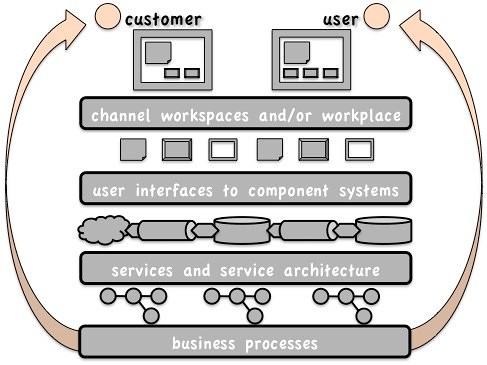
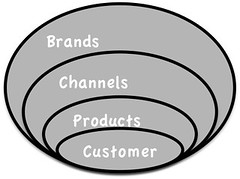
For us IT does matter! We compete based on our abilities of using IT to bring the best products and processes to the market. Technology is our production engine and information technology development is our business heart. And 'single platform' is at the heart of our business model, a single banking platform, a single way of doing things, across all our banking brands and customer services. All our banking 'brands', including SB, will and do use the same platform, 'Single Platform', and the customer is at the core of this. 'Single Platform' is built on a SOA, a Service Oriented Architecture.
CustomerCentred
I can announce today that we reached agreement on our newest acquisition, our biggest and most complex yet, Lokalny Bank Polska (LBP) and its Baltic brands. How will we achieve this, our largest integration so far? That’s why we have our offshore development and shared services centre partnership with one of India's fastest growing IT companies. They will assist some of the projects. We chose the partner that we ‘liked’, that had the same ‘model’ in mind as we had ourselves. And also of course an aspect, that we wanted a partner where we use two, three, four hundred developers but we would still be very important to them. If we needed to scale and that was really important for us but we had chosen a bigger company like Infosys or Tata, then maybe it wouldn’t be as important for Infosys or Tata.
IEB_developers
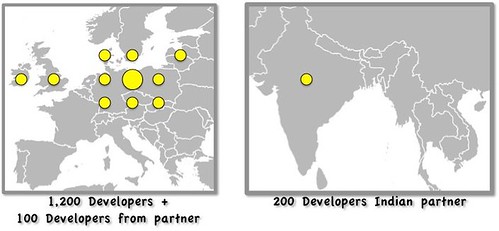
We started off in India in October last year and the plan was to steadily increase the number of employees, first ten, twenty, thirty, forty. But now the LBP opportunity develops, for this big project we have to do twenty hundred man-years of development in one year alone. We are currently twelve hundred developers across Northern Europe. They, I should say 'we' now have two hundred developers in India and a hundred or so in our Head Office, and we’ve added a lot of external contractors as well. Our partner, they’re doing the actual hiring of the people for us. And they are running Customer satisfaction call centre services as well, they actually have the Customer responsibility in some way, and actually, we treat them just like employees. They are developing using our development process, totally the same thing. Of course the training cost to bring them in, is a little bit higher, we use CMMI, that’s what they’re used to doing as well, so our development process is not different.

The development model also it’s the same development model for all persons. We are running CMMI projects, and it’s very much based on CMMI and focusing on CMMI disciplines, because, you cannot run too many different systems at the same time. Our development model is now compliant to CMMI level three. Many of our projects are close to being level three. But on average it’s only a little bit on top of level 2. In the past, we’ve had always quite good people, so we’ve been able to succeed with our projects, but sometimes, actually we’ve been able to succeed with a project even though the processes were not very good. So of course there’s a lot of advantage in being better at doing the work, but I think the most important thing, is if we, with the governance process, can ensure that we actually do the right work.

Selected quotes from an interview with Stuart, VP Digital of International European Bank (IEB), on sourcing, supplier selection and governance. Identities and names anonymised.
"We consider ourselves to be a technology driven boutique operation. We control the banking service-bus, the middleware. Control of the middleware, our API, is the heart of the bank." 
"Engagement over the tendering process was crucial; and what clinched it for us was culture matching. The culture match between us was crucial. Plus, we wanted a supplier that wasn't too large, one in which it mattered to them, that we were special, that we are big enough to appear on their corporate radar, that we matter." 
"We can outsource services, but we can't outsource our obligations. Because of that it cannot be a 'black box', you can never really step away from it. My approach is to 'see' but don't touch. Let the SLAs and KPIs work for you but it shouldn't be a black box, the box should be transparent. I want to see inside, if it's steam coming from a working engine or smoke from a fire."

We need warm bodies! (case)

Andrew (the firm's COO) has been having discussions with a specialist outsourcing firm from India and is meeting with Chris (CEO) and Charlie (VP Engineering) this morning. Chris has just returned from a state trade mission to China, and Charlie has been researching software development capabilities in the US, South America and Eastern Europe.

Profits are 40% of revenue, enough to plough investment back into numerous new product development and R&D projects. The ‘cash cow’ is a third-generation (mature) application that continues to generate substantial new sales and deliver a reliable stream of lucrative annual support fees. The firm's strategy so far has been to drive sales in new markets. They have achieved this by being close-to-the-customer, putting skilled engineers and sales people on site or in-country.

The first item on today's agenda is hiring. Andrew, Chris and Charlie reviewed a proof copy from HR of the job advertisement for next Friday's job section (see below) but are undecided about the value of 'yet another' advertising led recruitment initiative. For all the effort of the last six months of advertising, rounds of interviews and eventual job offers little has changed; not enough software engineers for the volume of work that needs to be done. In some ways the problem has become worse, of the last 25 job offers; 18 had rejected, preferring to take up positions in start-ups or larger American multinationals. The problem of attracting, hiring, and retaining talented software engineers is a major issue at all the firm's offices (New York, Boston, Houston, San Francisco, Sydney, Perth, Tokyo, Munich, Geneva, Dublin). Salary inflation reflects a tightening of the supply of qualified personnel and increasing costs are having an impact on the firm’s  profitability and stock price.

In-house engineer turnover and burnout is also a big issue. The fact is that the firm is struggling with a limited supply of IT professionals in local markets and is finding it difficult to convince the firm's own engineers to work on essential product porting and maintenance, or support on existing products. Turnaround and resolution times for escalated support issues has grown and the quality of patches and service packs released to customers is suffering as more experienced senior engineers prefer to work on 'more interesting' new-product projects.


Proof Copy: Job Advertisement for FIRM

Area: Engineering/Product Development
A Web 2.0+ engineering team focused on solving tough problems delivering highly usable solutions that build and leverage social networks.

Role & Responsibilities: Software Engineer
  • You will help to design, implement, and improve our Ruby-on-Rails based web platform, developing data intensive responsive cloud hybrid web applications.
  • You will be working with a modern toolkit on really exciting projects that you will help define, refine and deliver.
  • You love learning, learning with others, teaching and learning, listening (learning) and creating things.
  • You like to get things done, up and running and finished, with just enough polish.
  • You take responsibility for your own work, help others, and willingly receive help.
  • You will (as does everyone else) also contribute to essential porting, maintenance, and support for existing applications on platforms like OS/390, some mobile devices and ancient legacy systems.
  • You will work with Git, svn, or other cvs for code management; lighthouse for issue tracking and collaboration/communication tools such as Skype, Basecamp, blogging, and especially *wiki for team communication and project management.
Requirements:
  • Experience! (or BSc or Masters in Computing, Informatics, Engineering etc.)
  • Excellent team skills working with other engineers, non-engineers, and especially users/customers.
  • Open-source participation and server admin know-how (*nix and MS) a big plus.
  • Ruby-on-Rails, interfacing apps with 3rd party services like Twitter API via OAuth
  • Postgresql but also accept MySQL or similar framework and DB system.
  • Comfortable with agile software development practices but appreciative of waterfall rigor for deployment and delivery.

Symantec moves off-shore (case)

"The problem with success" thought Gordon Eubanks “is you need to keep changing the game to keep winning".
Gordon had achieved outstanding success in the software market in the US in a host of software product and utility categories (programming languages, antivirus, disk management and more). The company had developed in-house products and acquired competitors such that it was now the dominant supplier of these products in the US. What was left was the rest of the world; the question was how?

The Symantec board was meeting to review plans for the next stage in the company's expansion. Their strategy was to transform Symantec from being a national leader into the global brand for computer utilities and productivity applications. The corporate target was to reach sales revenues of over 100 million a quarter within three years. International sales already accounted for around 5 million dollars a quarter over the last financial year and its value was growing but not fast enough. International customers wanted software in their own languages, not just English. This meant localised versions with translated or enabled software interfaces AND help systems, user guides, packaging, marketing etc. It also meant that the software had to be tested on the types of computers and operating systems in use in those markets.

Some thought it odd that a company with its roots in LA and San Francisco had yet to produce a Spanish-language version of any of its products. But computing was a science and industry that had long neglected the needs of non-English language users. Gordon wasn't even sure if his products could be localised without more or less radical rewrites and redesign. Software with hard-coded strings and assumptions about character sets were embedded throughout most of the products. Then there was the Manufacturing challenge. The company was going to need boxed versions in German, French, Spanish, Italian, Swedish; they might even need to release a version of each product in UK English if the sales justified the cost or customers demanded it. And then there was ‘double byte’, the Asian markets Japan and China.

The company currently manufactures around 200 SKUs (stock-keeping units) for products in American English sold in the US and to the rest-of-world (ROW). With localised versions of all product lines they would end up with over 1,000 new SKUs to manage and maintain in the first year alone. Gordon considered his options; he could outsource manufacturing to 'turn–key' providers, manage the job 'in-house', or leave it to resellers and distributors to create localised versions and handle the manufacturing for each national market. The current reseller agreement with Softbank in Japan was just like that. Softbank did localisation and translation but it also got to keep most of the sales revenue. Japanese language versions of their products attracted a lucrative premium. OEM (original equipment manufacturer) deals with non-US PC manufacturers bundling 'lite' versions could also bring more money while at the same time reaching new customers who might then upgrade to 'full' versions or pay for monthly updates.

Should a single division be given responsibility for all language and manufacturing or should the work be farmed out to each national office? The problem with leaving it to resellers or country sales offices was one of quality control, marketing and message management. Can you imagine having one 'country version' translating the product name one way and another choosing to go with the English title? Should Symantec establish an international base and if so where? Gordon's erstwhile competitor Mitch Kapor, the creator of 'Lotus Notes' had established a software lab in Dublin, Ireland, but Israel and India also had growing software services and manufacturing sectors. Having a headquarters based inside the European Economic Community might avoid import tariffs if products were manufactured and had value added in Europe. There were also favourable corporate tax rates on profits in some countries.
Gordon pondered, “does success follow the money... or is it that money followed success?"


Why Ireland?
The Irish Development Agency (IDA) promotes Ireland as a 'pro-business' environment (www.idaireland.com - Investment Ireland). The IDA summarises the benefits of Ireland as follows:
  • a favourable tax regime,
  • a young and talented workforce,
  • a critical mass of relevant supporting industry and infrastructure,
  • a unique political and social commitment to supporting FDI and multinationals,
  • and excellent managerial talent.
The 2008-2012 Business Environment Ranking of the Economist Intelligence Unit placed Ireland 11th globally out of 82 countries.


Invest in Israel
Israel's Ministry of Industry, Trade and Labor (and www.investinisrael.gov.il/) promotes Israel as an investment destination based on the following criteria:
  • a positive business climate (access to venture capital, access to international markets),
  • an exceptional workforce (educated, entrepreneurial and multi-lingual),
  • investment incentives (grants, supports, structures)
Israel invests 4.5% of its GDP in R&D, which is the highest ratio of any country in the world (IMD World Competitiveness Yearbook 2008).


India: Why Maharashtra?
The Maharashtra Industrial Development Corporation (www.midcindia.org) - MIDC - of Maharashtra State (capital Mubai, regional centres Pune and others) claims the state as a proactive driver of inwards investment and support for entrepreneurs. It "continues to attract the largest quantum of investments, both domestic and foreign". Maharashtra's strengths include:
  • high literacy,
  • good infrastructure (power, ports, airports, rail, and road),
  • global players already based there,
  • access to an educated workforce,
  • surrounded by India's most prestigious universities and research institutes,
A joint survey of leading Indian States conducted by the World Bank along with the CII, found that Maharashtra has the best investment climate.